

Cemetery Negligence: What Families Can Do
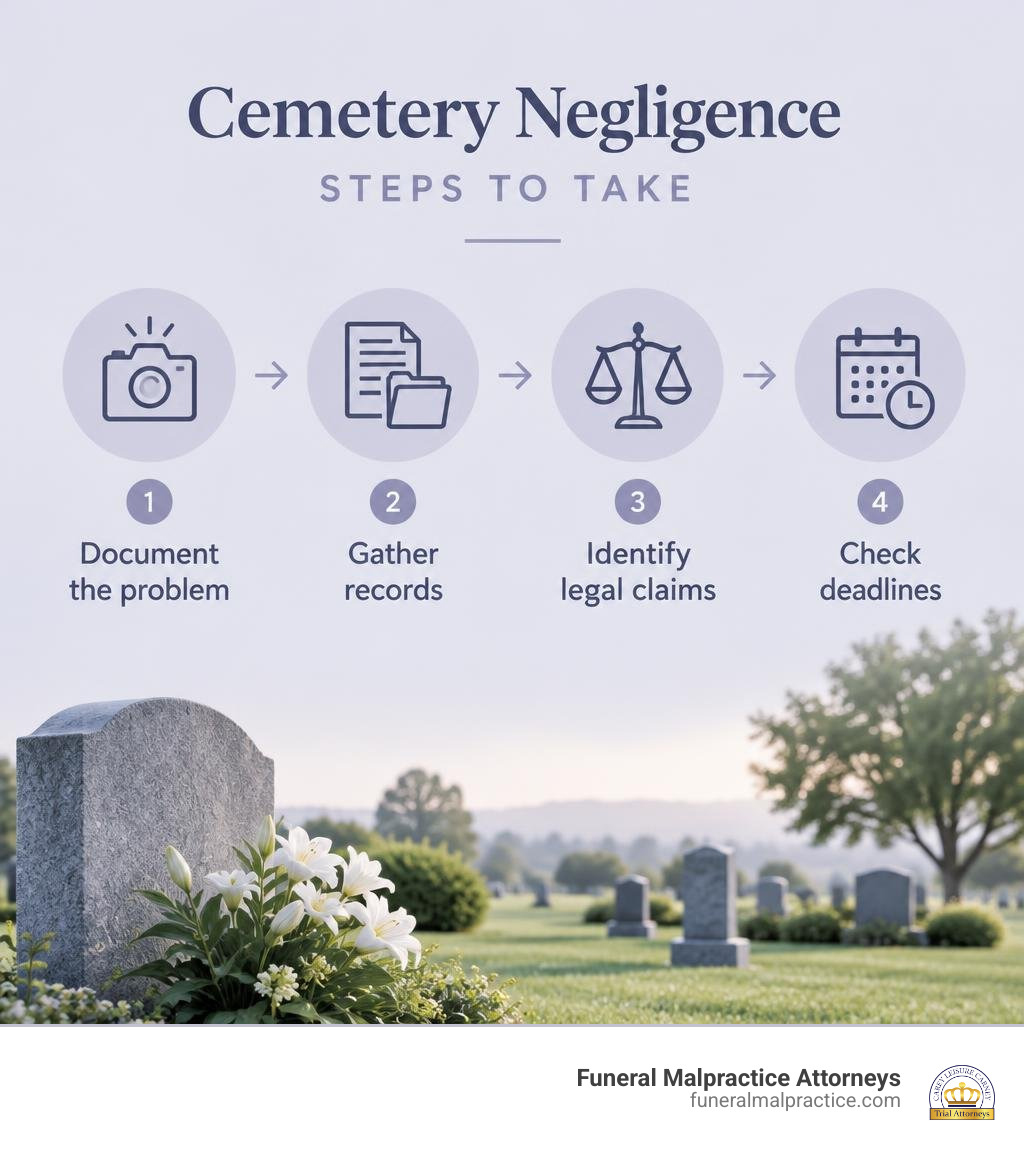
Cemetery negligence can involve an unsafe gravesite, a burial in the wrong plot, damaged markers, or mishandled remains. If you suspect a problem, photograph what you can, save your plot agreement and messages, and ask the cemetery for relevant records in writing. Speak with an attorney promptly because legal deadlines may apply.
Your options depend on what happened. A family may have a claim based on unsafe grounds, a broken burial agreement, or interference with burial rights. Emotional distress may also be recoverable, but the rules vary by state.
I’m Tom Carey, a Florida-based legal professional who has served as a senior partner in Pinellas County. I draw on my legal practice experience to explain cemetery negligence and the steps families can take to protect their rights.
When we entrust the remains of our loved ones to a memorial park, we expect dignity, respect, and meticulous care. Approximately 2.6 million resident deaths occur in the United States each year, and the population dies at a rate of roughly 0.65 deaths for every birth. With millions of families visiting memorial grounds every year, the legal duties governing these sacred properties are essential to preserving peace of mind and upholding the right of sepulcher.
Understanding Cemetery Negligence and Legal Duties of Operators
Cemetery operators, whether private corporations, religious associations, or municipalities, must maintain their grounds in a reasonably safe condition and honor their contractual and statutory commitments. When an operator fails to meet these obligations, the resulting harm often spans physical injury, property damage, and intense emotional trauma. In legal terms, pursuing accountability falls under the broader scope of cemetery malpractice.
The scope of duty owed to an individual on cemetery grounds depends heavily on property maintenance standards, municipal ordinances, posted operating hours, and the visitor’s legal classification under premises liability law.
Premises Liability and Visitor Legal Status
Under standard premises liability doctrine, the duty of care owed by a cemetery operator changes based on why and when a person enters the property:
- Invitees: Grieving family members, funeral attendees, and plot purchasers visiting during regular operating hours are business or public invitees. Operators owe them the highest standard of care, which includes inspecting the grounds, repairing hidden dangers, providing adequate soil compaction over recent graves, and warning of known hazards like sinkholes, uneven turf, or toppled headstones.
- Licensees: Individuals entering the grounds for their own convenience with permission (such as taking a shortcut during open hours) are licensees. Operators must refrain from willful or wanton harm and warn of known, concealed dangers.
- Trespassers: Anyone entering the grounds outside posted visiting hours or venturing into clearly marked restricted zones is generally classified as a trespasser.
The legal significance of operating hours was examined in Lisa DeWolf v. Town of Newington et al. (2014), where a visitor fell into an unstable, freshly compacted grave surface after posted cemetery hours. The court reiterated that a property owner generally owes a trespasser only the duty to avoid intentional, willful, or reckless injury, unless the operator has actual knowledge or constructive notice of regular, habitual intrusions in that exact location.
| Visitor Classification | Criteria | Standard of Care Owed by Cemetery |
|---|---|---|
| Invitee | Regular visitors, family plot holders, funeral attendees during open hours | Highest duty: proactive inspection, regular grounds maintenance, prompt repair of hazards, adequate warnings |
| Licensee | Social visitors with implied consent, permitted passersby | Moderate duty: warn of known hidden dangers, avoid willful misconduct |
| Trespasser | Individuals entering after posted closing hours or into restricted areas | Limited duty: refrain from intentional, reckless, or wanton harm; reasonable care only if known pattern of trespass exists |
Municipal Cemeteries and Governmental Immunity
When a city or county manages a public burial ground, claims are subject to statutory immunity protections. Under statutory frameworks such as Connecticut General Statutes § 52-557n, political subdivisions can be held liable for personal injury or property damage resulting from negligent acts or omissions by their employees, provided those acts fall within the scope of employment.
However, a critical distinction exists between ministerial duties and discretionary acts:
- Ministerial Duties: Tasks prescribed by law, formal policy, or direct operational mandates that leave no room for personal judgment (e.g., properly filling a grave opening to a specified standard or maintaining basic path safety). Negligence here often circumvents immunity.
- Discretionary Acts: Broad decisions involving municipal planning, allocation of budgetary resources, or policy design. Qualified immunity often shields municipal employees and entities from negligence claims arising out of discretionary decisions, unless a recognized statutory exception applies.
Core Causes of Action in Burial and Interment Disputes
Cemetery disputes extend well beyond slips and falls on unkempt grass. They frequently involve the violation of fundamental rights regarding how a body is handled and memorialized, bridging tort law, contract law, and quasi-property rights.
Common Grounds for Lawsuits Involving Cemetery Negligence
Families facing cemetery mismanagement frequently encounter severe systemic errors. When these situations arise, the misconduct often overlaps with broader funeral malpractice concerns, including:
- Erroneous Interment: Burying a casket in an incorrect plot or double-stacking vaults without authorization.
- Lost or Commingled Remains: Failing to track remains through proper chain-of-custody protocols, occasionally leading to misidentified cremations.
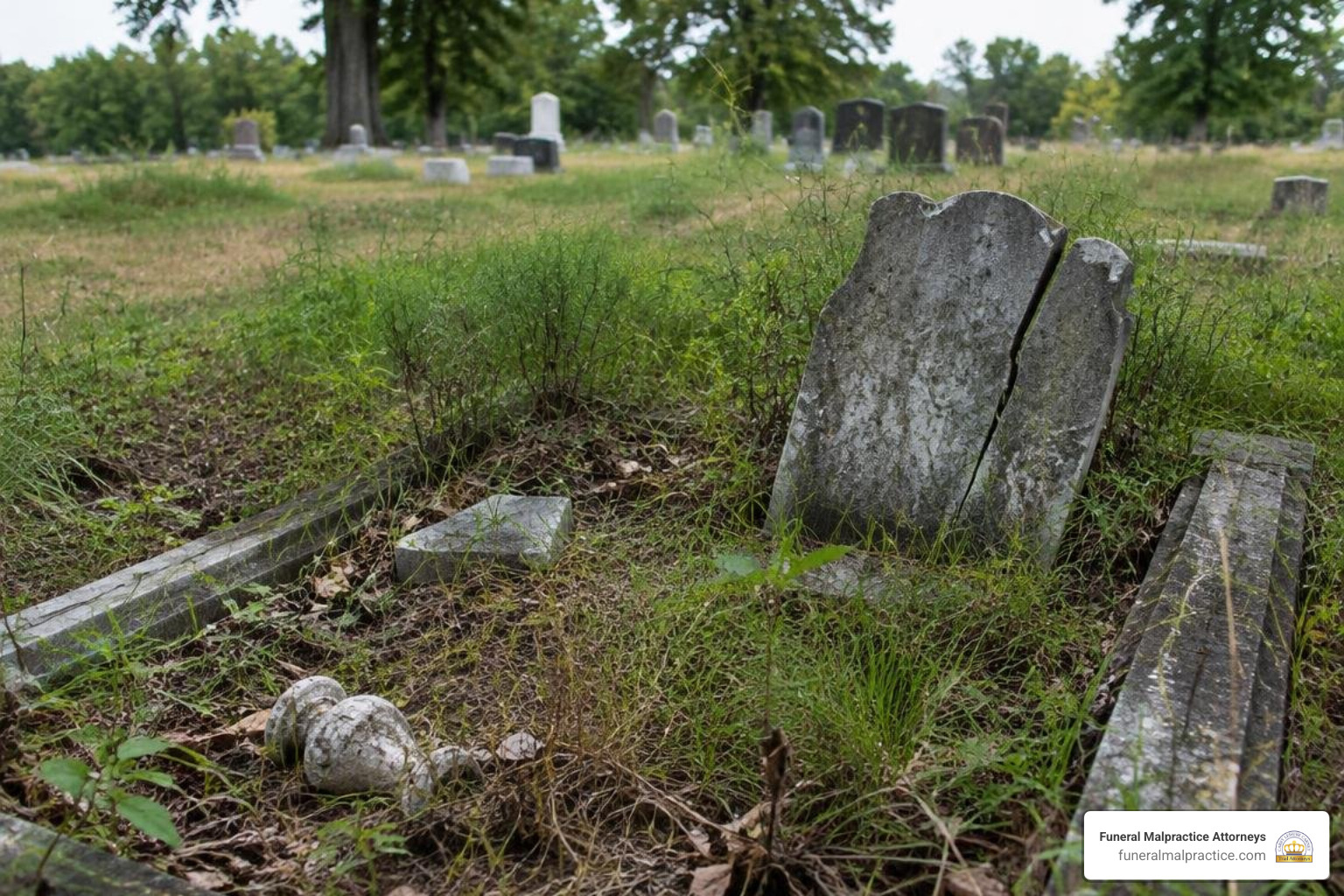
- Grounds Neglect and Desecration: Permitting overgrowth, broken markers, erosion, or sunken graves that mar the dignity of the gravesite.
- Unauthorized Disinterment: Moving remains without obtaining mandatory state permits or the explicit consent of the statutory next of kin.
To better understand how these claims are structured, you can review our breakdown of understanding funeral malpractice and common legal grounds for claims.
Intentional and Negligent Infliction of Emotional Distress
Because human remains hold sacred emotional value rather than ordinary commercial worth, plaintiffs in burial disputes frequently bring claims for Intentional Infliction of Emotional Distress (IIED) or Negligent Infliction of Emotional Distress (NIED).
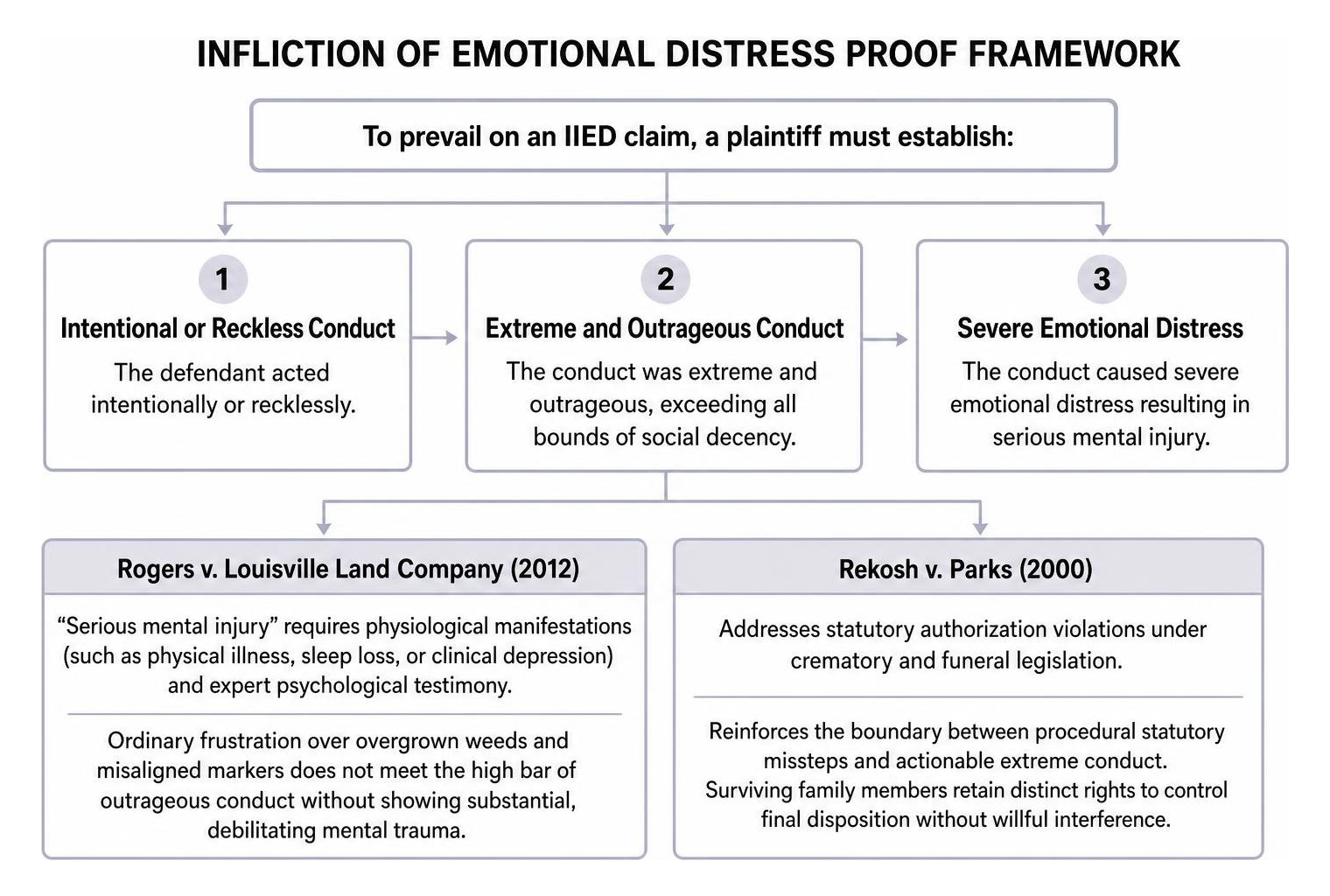
To prevail on an IIED claim, a plaintiff must establish:
- The defendant acted intentionally or recklessly;
- The conduct was extreme and outrageous, exceeding all bounds of social decency;
- The conduct caused severe emotional distress resulting in serious mental injury.
In Rogers v. Louisville Land Company (2012), the Supreme Court of Tennessee clarified what constitutes a “serious mental injury” in cemetery maintenance litigation. The court noted that while physiological manifestations (such as physical illness, sleep loss, or clinical depression) and expert psychological testimony are vital evidence, ordinary frustration over overgrown weeds and misaligned markers does not automatically meet the high bar of outrageous conduct without demonstrating substantial, debilitating mental trauma.
Similarly, in Rekosh v. Parks (2000), the court addressed statutory authorization violations under crematory and funeral legislation. The court highlighted the delicate boundary between procedural statutory missteps and actionable extreme conduct, reinforcing that surviving family members retain distinct rights to control final disposition without willful interference.
Burial Plot Contracts and Heir Rights
When an individual buys a cemetery plot, they rarely purchase fee-simple real estate. Instead, the law generally treats a burial plot deed as an easement or an irrevocable license for the exclusive purpose of interments.
Heirs inherit this privileged easement and retain full standing to enforce the original contract. In Jakeman v. Lawrence Group Management Company, LLC, et al., a family discovered that an unrelated person had been erroneously interred in their ancestral plot. The court affirmed that heirs have the legal right to enforce burial agreements, seek damages for breach of contract and conversion, and obtain injunctive relief ordering the cemetery to disinter the mistakenly buried individual.
Insurance Coverage and Procedural Considerations
When families file suit for burial errors, resolving the dispute often depends on the cemetery’s commercial general liability (CGL) coverage and professional liability riders.

The Definition of “Occurrence” and Policy Exclusions
A central battleground in cemetery litigation is determining when an insurance “occurrence” happens and whether policy exclusions apply. As explored in Rising from the Dead: A Jurisprudential Review of Recent Cemetary and Human Rights Cases, courts must balance complex chain-of-custody rules with tort principles.
In Memorial Properties LLC v. Zurich American Insurance Co. (2011), the court addressed insurance coverage disputes arising from the unauthorized harvesting of human tissue. The court established that for indemnity purposes, an occurrence is triggered when the claimant discovers the injury and suffers emotional harm, rather than when the underlying physical act took place.
However, many general liability policies contain explicit exclusions for the “improper handling” of dead bodies. When an insurer successfully invokes an improper handling exclusion, the cemetery operator must pay defense costs and settlements out of pocket. For families seeking guidance when physical evidence is compromised, knowing what to do if you suspect the cremated remains are not your loved ones is critical for preserving legal remedies before insurance timelines lapse.
Statute of Limitations and Procedural Rules in Cemetery Negligence Claims
Burial disputes carry strict filing deadlines:
- Accrual and the Discovery Rule: The statute of limitations generally begins to run when the family discovers—or reasonably should have discovered—the wrongful act or injury.
- The Relation Back Doctrine: If a plaintiff amends their initial complaint to clarify facts or refine claims against a cemetery or municipal entity, the amendment can “relate back” to the original filing date, provided the initial complaint gave the defendant fair notice of the general transaction or occurrence.
Frequently Asked Questions About Burial Disputes
What standard of care do cemeteries owe to visitors and plot owners?
Cemeteries must exercise reasonable care to keep pathways, gravesites, and common structures free of dangerous conditions for regular visitors (invitees). They must also adhere to state maintenance regulations, preserve plot boundaries, and fulfill all interment specifications in the burial contract.
Can heirs sue if a cemetery mistakenly buries someone else in their family plot?
Yes. Heirs hold an inherited easement privilege in family burial spaces. If a cemetery permits an unauthorized interment in that plot, the heirs can sue for breach of contract, trespass, and conversion, and can seek an injunction requiring the cemetery to move the remains at its own expense.
How does the discovery rule apply to insurance claims for mishandled remains?
The discovery rule dictates that the clock for insurance occurrences and legal statutes of limitation starts when the family learns of the mishandling, not when the physical error originally happened underground or in the crematory years earlier.
Conclusion
Discovering that a cemetery has neglected your loved one’s final resting place, disrupted a family plot, or mishandled human remains is a distressing experience. Preserving photographic evidence, securing contractual receipts, and seeking prompt legal guidance can help you hold operators accountable and protect your family’s rights.
At Funeral Malpractice Attorneys, we provide dedicated support to families facing complex funeral and cemetery disputes. If your family is dealing with gravesite desecration, unkempt grounds, or interment errors, reach out today for a free consultation and learn how our dedicated cemetery malpractice representation can help you secure the accountability and closure your family deserves.