
Can You Sue a Funeral Home for Negligence?
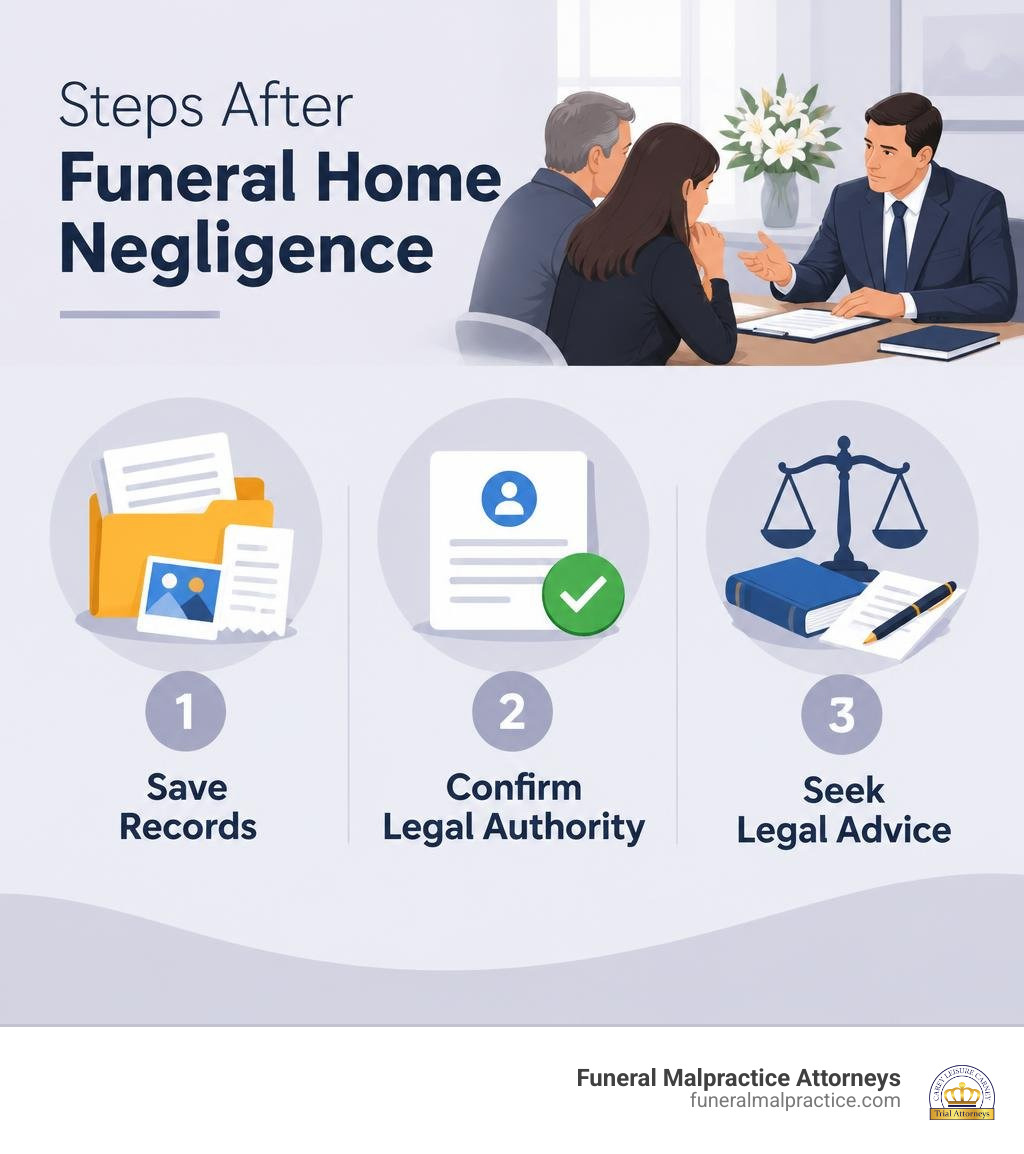
Yes, you may be able to sue a funeral home for negligence if it mishandled remains, ignored authorized instructions, or failed to provide services with reasonable care, causing harm. Save the contract, written instructions, messages, receipts, and photos. Then find out who had legal authority over the arrangements and speak with a lawyer promptly, because filing deadlines vary by state.
I’m Tom Carey, a Florida-based legal professional who has served as a senior partner in Pinellas County. If you’re asking “can you sue a funeral home for negligence,” I’ll use my legal experience to walk you through the key questions.
When Can You Sue a Funeral Home for Negligence?
When we entrust a deceased loved one to a funeral home, crematory, or cemetery, we place immense emotional faith in their professional standards. Unfortunately, mortuary staff sometimes fail to exercise reasonable care. In legal terms, mortuary malpractice occurs when a facility breaches its duty of care, directly causing severe emotional distress, psychological trauma, or financial loss to surviving family members.
To successfully bring a lawsuit, your claim must satisfy four core legal elements:
- Duty of Care: The funeral home entered into a professional relationship or contract with the family, creating a legal duty to handle the decedent’s remains with dignity, respect, and standard industry care.
- Breach of Duty: The mortuary or its staff failed to meet the accepted standard of care through an act of omission, carelessness, or direct violation of statutory guidelines.
- Causation (Proximate Cause): The facility’s specific failure directly led to the injury or emotional devastation suffered by the family.
- Damages: The surviving family members suffered quantifiable harm, most commonly severe mental anguish, clinical psychological trauma, or out-of-pocket financial expenses.
When a mortuary fails in these duties, families often require specialized funeral malpractice representation to hold the facility accountable.
Common Examples of Mortuary Negligence
Mortuary negligence takes many forms, ranging from administrative record errors to shocking physical mishandling of human remains. Common scenarios include:
- Embalming and Preservation Failures: Inadequate chemical treatment, failing to set refrigeration properly, or delaying embalming, which causes accelerated decomposition and creates offensive odors during viewings.
- Body Identification Mix-ups: Presenting the wrong decedent in an open casket or dressing the wrong body in family-provided garments.
- Casket and Grave Site Errors: Dropping caskets during transport or lowering, failing to properly seal burial vaults, or digging graves in incorrect cemetery plots, which necessitates disinterment. These often form the basis of cemetery malpractice lawsuits.
- Cremation Mishandling: Instances of crematory malpractice such as performing unauthorized cremations, losing cremated remains (cremains), or commingling the ashes of multiple individuals in a single urn.
Can You Sue a Funeral Home for Negligence in Body Mishandling Cases?
Mishandling of human remains represents one of the most egregious forms of mortuary negligence. Mortuaries must maintain an unbroken chain of custody and positive physical identification at every stage of transport, storage, and preparation.
When facilities suffer refrigeration failures, leave bodies unattended in uncooled storage areas, or mix up identification tags, the emotional trauma inflicted on surviving relatives can be overwhelming. Legal practitioners handling mortuary claims frequently evaluate established remains-mishandling legal standards to establish that a mortuary’s failure to safeguard human remains constitutes an actionable tort.
Legal Theories: Negligence vs. Breach of Contract
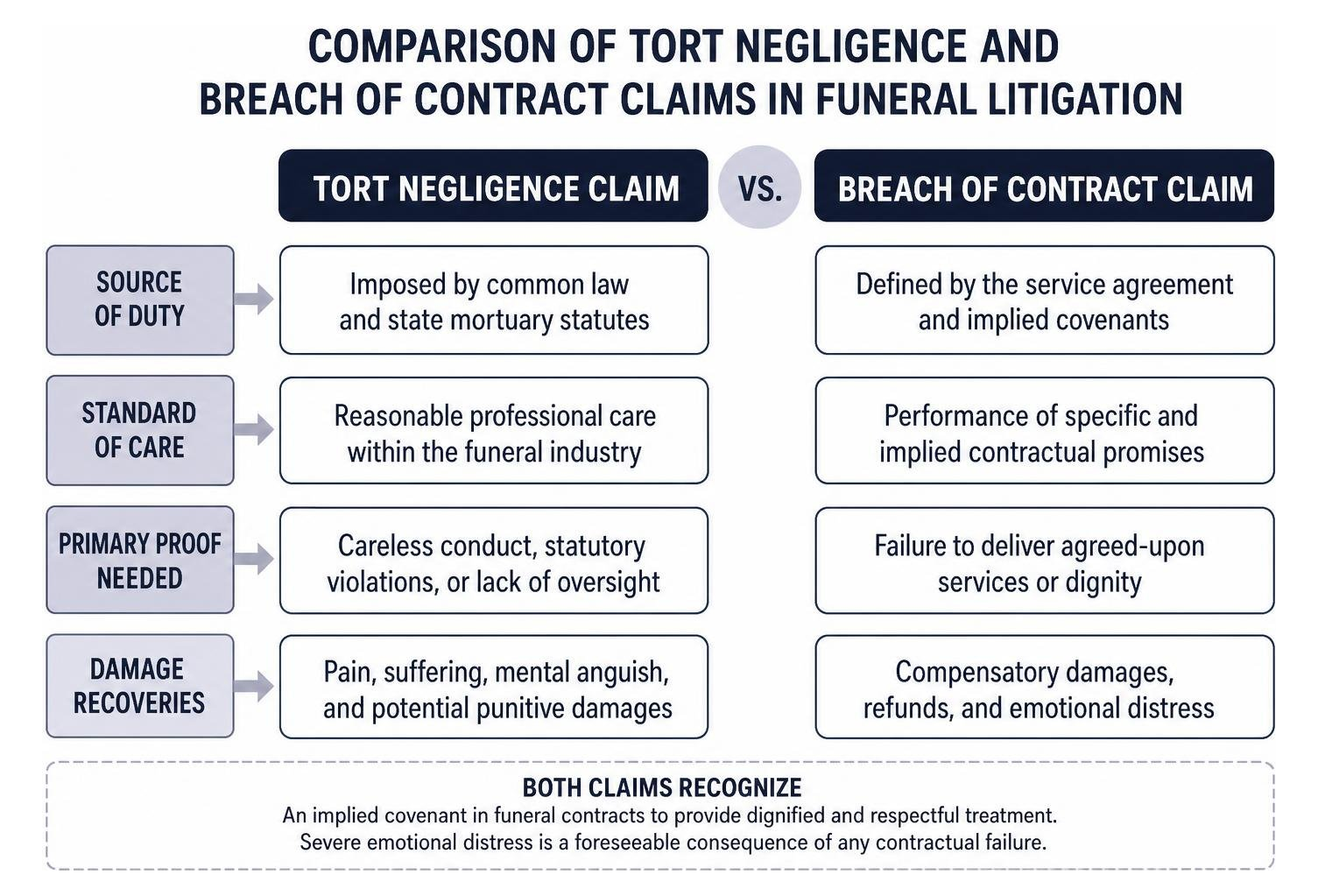
When filing a lawsuit against a mortuary, plaintiffs typically bring claims under two primary legal theories: tort negligence and breach of contract.
| Legal Element | Tort Negligence Claim | Breach of Contract Claim |
|---|---|---|
| Source of Duty | Imposed by common law and state mortuary statutes | Defined by the service agreement and implied covenants |
| Standard of Care | Reasonable professional care within the funeral industry | Performance of specific and implied contractual promises |
| Primary Proof Needed | Careless conduct, statutory violations, or lack of oversight | Failure to deliver agreed-upon services or dignity |
| Damage Recoveries | Pain, suffering, mental anguish, and potential punitive damages | Compensatory damages, refunds, and emotional distress |
Unlike standard commercial transactions, contracts for funeral services are inherently personal. Courts recognize an implied covenant in funeral contracts to provide dignified and respectful treatment.
Because the primary subject of the contract is the final disposition of a loved one, severe emotional distress is a foreseeable consequence of any contractual failure. Landmark legal rulings, including precedent on emotional anguish from mortuary contract breaches, confirm that surviving family members can recover damages for mental suffering when a funeral director fails to preserve a body properly or fails to warn family members of unpleasant conditions prior to a viewing.
Employer Liability for Staff and Contractors
Under the legal doctrine of respondeat superior (vicarious liability), funeral homes are legally responsible for the negligent acts and omissions of their employees carried out within the scope of employment.
If an embalmer, driver, or funeral director acts carelessly, the parent business entity bears financial liability. Furthermore, if a funeral home subcontracts transportation, storage, or cremation to third-party vendors without verifying their licensing or facilities, the contracting funeral home may be held liable for negligent hiring, negligent retention, or failure to supervise.
Legal Standing and the Right of Sepulcher
A central legal issue in mortuary litigation is standing: who holds the lawful right to file suit? Under American common law, human remains are not commercial property, but the law grants surviving relatives a “quasi-property” right known as the right of sepulcher.
The right of sepulcher grants designated family members the absolute legal authority to possess the body for burial or cremation, determine final disposition, and ensure the body is treated with uninterrupted dignity.
State statutes establish a clear hierarchy dictating who holds the legal right of disposition:
- A person designated by the decedent in a legally binding written directive or will.
- The surviving lawful spouse.
- Adult biological or legally adopted children (acting by majority consensus).
- Surviving parents.
- Adult siblings.
- The decedent’s legal personal representative or next closest kin.
Federal courts assessing disputes over mortuary decisions frequently examine these state priority hierarchies, as seen in recent federal case analysis on right of disposition. Mortuaries that bypass the rightful next of kin to take instructions from unauthorized relatives or third parties can face immediate liability for interfering with the right of sepulcher.
Can You Sue a Funeral Home for Negligence as an Estranged Relative?
Statutory priority is not always absolute. In many jurisdictions, laws explicitly state that if a surviving child or spouse was legally estranged from the decedent at the time of death, they forfeit their statutory right of disposition.
Funeral directors who receive conflicting instructions from estranged biological children versus other family members or appointed stepchildren must tread carefully. When a funeral home follows a decedent’s explicit, authenticated pre-need directives over the verbal demands of an estranged relative, the facility often holds a strong legal defense against subsequent claims.
Proving Damages and Recovering Compensation
The primary harm in funeral malpractice cases is almost always psychological rather than physical. In traditional personal injury law, the “impact rule” historically barred plaintiffs from recovering emotional distress damages without physical impact or bodily injury. However, courts across the country have created a clear exception for mortuary cases.

Because mortuary services inherently deal with intense grief, mental suffering is considered the direct, natural, and foreseeable result of mishandling a deceased loved one. Families may recover various forms of financial compensation, including:
- Compensatory Emotional Damages: Compensation for severe mental anguish, post-traumatic stress disorder (PTSD), anxiety, clinical depression, sleep disruption, and grief aggravation.
- Economic Losses: Out-of-pocket medical and psychological therapy costs, reimbursement of funeral service fees, cemetery plot purchase expenses, or costs associated with disinterment and reburial.
- Punitive Damages: Special damages awarded in cases involving gross negligence, willful misconduct, intentional concealment, or reckless indifference (such as deliberately hiding an embalming failure or commingling ashes to save time).
Every state enforces a strict statute of limitations that sets a deadline for filing a mortuary negligence lawsuit. While personal injury and malpractice deadlines generally range between one and four years depending on your jurisdiction, the “discovery rule” may pause or extend this clock if the funeral home actively concealed its misconduct and the family only discovered the error at a later date.
Step-by-Step Guide to Evaluating and Filing a Claim
If you suspect that a mortuary, cemetery, or crematory mishandled your loved one’s arrangements, taking organized action immediately preserves critical evidence:
- Secure All Documentation: Gather the signed funeral service contract, itemized billing receipts, pre-need agreements, written disposition directives, text messages, and email exchanges with mortuary personnel.
- Document Physical Evidence: Take clear, time-stamped photographs or videos of relevant issues, such as incorrect gravestones, damaged caskets, or physical site conditions.
- Request Chain-of-Custody Records: Formally request all internal transport logs, embalming reports, refrigeration temperature tracking records, and cremation verification certificates from the facility.
- Obtain Medical and Therapy Records: If you or your family members require psychological counseling, psychiatric care, or medical intervention due to emotional distress, maintain detailed medical records and invoices.
- File a Regulatory Complaint: Submit an official administrative complaint to your state’s licensing board for funeral directors and embalmers to trigger a formal state investigation.
- Review Common Questions and Consult Legal Counsel: Review frequently asked questions about mortuary claims and consult an attorney focused on funeral malpractice to protect your rights before statutory deadlines expire.
Frequently Asked Questions About Funeral Home Lawsuits
How long do you have to file a funeral home negligence lawsuit?
The statute of limitations varies by state, typically ranging from one to four years from the date of the incident. Under the discovery rule, if the mortuary concealed an error (such as providing an empty urn or burying a body in the wrong plot), the filing deadline may begin on the date the family reasonably discovered the misconduct.
Can you recover damages for emotional distress without physical injury?
Yes. While traditional torts often require physical impact, funeral malpractice is a recognized legal exception. Because funeral contracts deal directly with sensitive family emotions, courts allow recovery for mental anguish and psychological harm without requiring an accompanying physical injury.
Who has the legal right to sue a funeral home?
The right to sue generally belongs to the individual or individuals holding the statutory right of disposition (the right of sepulcher). This hierarchy typically begins with a designated agent named in the decedent’s directives, followed by the surviving spouse, adult children, surviving parents, and siblings.
Conclusion
Discovering that a funeral home acted carelessly with a deceased family member compounds an already painful grieving process. You do not have to carry this burden alone. At Funeral Malpractice Attorneys, we provide dedicated, empathetic advocacy to hold negligent facilities accountable and secure the compensation your family deserves.
To review your options with our legal team, you can request a free consultation today or read our comprehensive guide to funeral malpractice to learn more about your rights.