

What Funeral Home Lawsuit Settlements May Pay
Funeral home lawsuit settlements can range from a few thousand dollars to six figures or more. Serious misconduct claims may settle for $50,000 to $250,000, but there is no reliable national average. The amount depends on what happened, the family’s financial losses, the harm they can document, and the strength of the evidence. A large court judgment is not the same as money a family will collect.
If you are trying to understand what your claim may be worth, start by saving the funeral contract, receipts, messages, and any proof of how the remains were handled. Those records help show both the loss and who may be responsible.
I’m Tom Carey, a Florida-based legal professional with experience as a senior partner in legal practice. That background informs how I explain funeral home lawsuit settlements and the factors that can affect a family’s recovery.
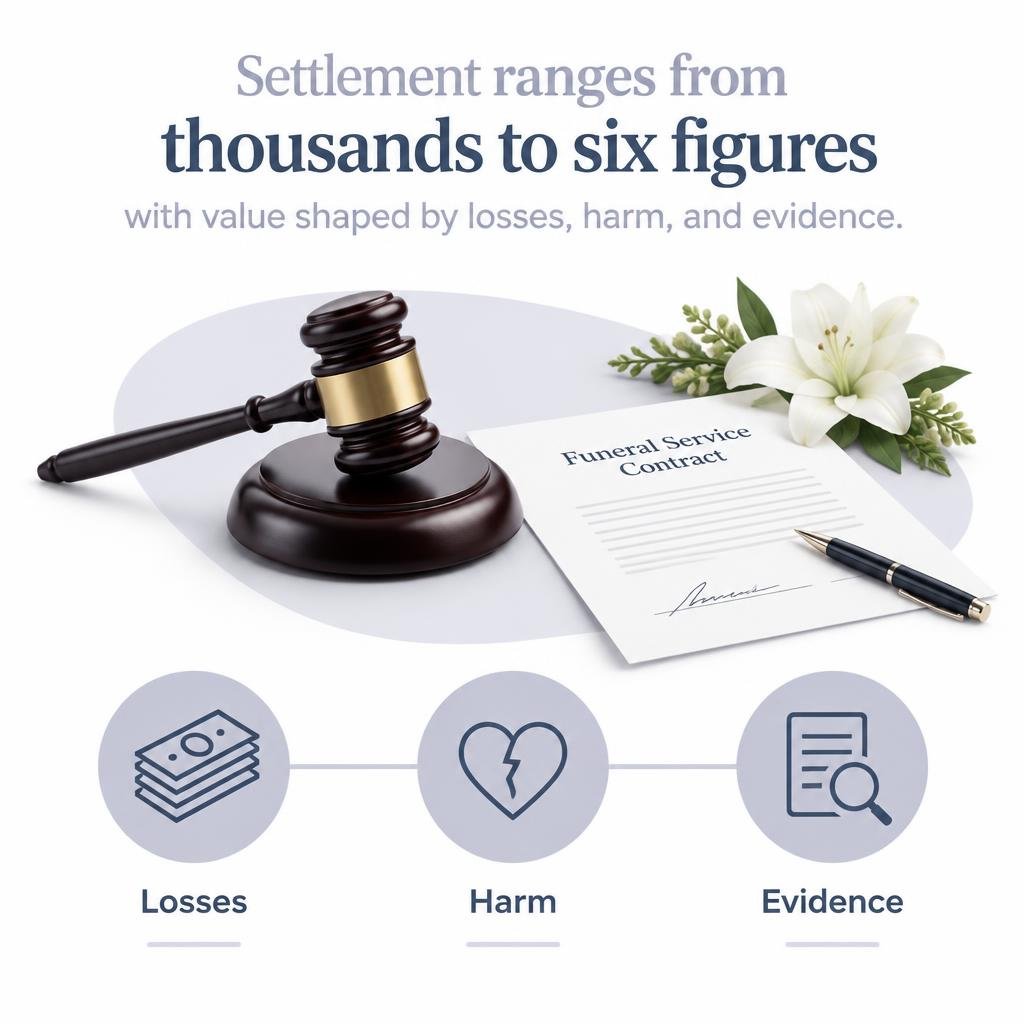
Key Factors That Determine Funeral Home Lawsuit Settlements
When a mortuary breaches its duty of care, determining the financial recovery requires looking beyond standard injury equations. Grieving the loss of a loved one is already one of the most painful experiences anyone endures; discovering that a trusted director exploited or mishandled your relative adds an overwhelming layer of trauma.
Evaluating a claim involves calculating tangible economic damages alongside intangible emotional harm, while staying mindful of statutory damage caps, insurance policy limits, and local jury tendencies. Navigating understanding funeral malpractice and common legal grounds for claims begins with understanding the distinct categories of damages available in civil litigation.
Economic, Non-Economic, and Punitive Damages
In mortuary litigation, financial compensation falls into three primary categories:
- Economic Damages: These represent verifiable out-of-pocket financial losses. They include the national median cost of a funeral with viewing and burial—roughly $8,300—along with burial plot fees, exhumation costs, re-interment fees, corrective cremation charges, and out-of-pocket medical or psychiatric expenses incurred to treat emotional distress.
- Non-Economic Damages: These compensate for mental anguish, grief, post-traumatic stress, and the profound violation of a family’s right to lay their loved one to rest with dignity. Non-economic damages often represent the largest portion of a recovery.
- Punitive Damages: Reserved for cases involving intentional malice, reckless indifference, or egregious fraud, punitive damages punish the bad actor and deter future wrongdoing. Because these require meeting a heightened burden of proof, they are not awarded in every case.
| Damage Category | Examples of Eligible Losses | Evidence Required |
|---|---|---|
| Economic | Funeral fees (~$8,300 median), exhumation costs, therapy invoices | Receipts, contracts, medical billing records |
| Non-Economic | Severe emotional distress, depression, loss of sleep, grief | Psychiatric evaluations, personal testimony |
| Punitive | Intentional body swapping, hidden decay, pre-need theft | Proof of gross negligence, fraud, or deliberate malice |
Typical Compensation Ranges in Funeral Home Lawsuit Settlements
Every lawsuit turns on its specific facts, but looking at broader payout benchmarks can offer clarity. In cases involving moderate negligence—such as minor delays, clerical mix-ups, or standard contractual disputes—settlements often range from a few thousand dollars to $50,000.
For severe misconduct involving body decomposition, severe embalming errors, unauthorized cremations, or the commingling of cremains, payouts frequently land between $50,000 and $250,000. Catastrophic cases involving widespread fraud, intentional desecration, or mass mishandling can result in six-figure and multi-million-dollar recoveries, as detailed in comprehensive funeral home lawsuit settlements: amounts and claims data.
Landmark Case Payouts and Regulatory Restitution Orders

When mortuary abuses reach systemic levels, both the civil courts and government regulatory bodies step in to secure massive judgments, civil fines, and consumer restitution. Families confronting grave abuses in burial grounds can pursue cemetery malpractice actions to hold these facilities accountable.
High-Profile Funeral Home Lawsuit Settlements and Major Verdicts
Several prominent legal battles illustrate the severe civil consequences of gross mortuary negligence:
- Return to Nature Funeral Home: In a historic ruling, a judge ordered the facility’s operators to pay a staggering $950 million default judgment after investigators discovered nearly 190 decaying human remains stacked in an unrefrigerated facility. Families were given fake ashes consisting of dried concrete mix while their relatives were left to decompose. This massive penalty was reported as a landmark Colorado funeral home judgment.
- Galilee Memorial Gardens: In this massive class-action dispute involving cemetery desecration, a jury found the cemetery 99% at fault and awarded families $7,500 per decedent for body mishandling, alongside a nominal $75 per decedent award against funeral director co-defendants. The litigation later sparked secondary legal actions when families alleged their lead counsel failed to communicate and accept multi-million-dollar settlement offers during trial proceedings.
Multi-Million Dollar State Enforcement and Consumer Restitution
Government enforcement actions frequently secure widespread financial relief for defrauded consumers:
- Neptune Society & Trident Society Settlement: Under an agreement negotiated by the California Attorney General, Service Corporation International (SCI) agreed to a $23 million settlement comprising full consumer restitution and substantial civil fines. SCI had allegedly misled customers purchasing bundled pre-need cremation plans by withholding full refunds when contracts were canceled, an enforcement action detailed in reports covering this statewide pre-need refund settlement.
- R.G. Ortiz Funeral Homes: The New York City Department of Consumer and Worker Protection (DCWP) secured over $604,000 in consumer restitution and $100,000 in civil penalties against this funeral home chain. The business was cited for failing to disclose the location of remains, presenting bodies in unacceptable states of decay, and misrepresenting prices, representing a key municipal consumer protection enforcement.
Common Grounds for Filing a Funeral Malpractice Claim

Negligence takes many forms. Families facing improper ash processing or unauthorized procedures often turn to crematory malpractice claims to address their injuries.
Mishandling, Commingling, and Unlawful Dispositions
The most emotionally devastating lawsuits stem from improper physical handling of decedents:
- Violation of the Right of Sepulcher: The absolute legal right of surviving next of kin to possess their loved one’s remains in the exact condition they were left at death and to determine their final disposition.
- Commingling of Ashes: Combining the cremated remains of multiple decedents or failing to properly clear out cremation retorts between procedures.
- Loss of Remains or Body Swapping: Mislabeling bodies, placing incorrect remains into casket viewings, or losing track of bodies entirely.
- Severe Decomposition and Embalming Errors: Failing to refrigerate remains promptly or performing substandard embalming that causes visible discoloration, leakage, or odor during open-casket viewings.
Pre-Need Fraud and Federal Funeral Rule Violations
Financial exploitation is another frequent driver of litigation. Under the Federal Trade Commission’s (FTC) Funeral Rule, providers must provide an itemized General Price List (GPL) to consumers before discussing arrangements. The FTC can levy civil penalties of up to $53,088 per violation against non-compliant providers.
In one notable federal enforcement action, the Manhattan U.S. Attorney settled a lawsuit against Harrison Funeral Home and its president for $32,000 in civil penalties alongside a comprehensive 20-year consent decree for failing to supply mandatory price sheets, as outlined in this federal trade practice settlement. Beyond pricing rules, severe fraud occurs when operators divert prepaid funeral trust funds to cover their own overhead or personal expenses.
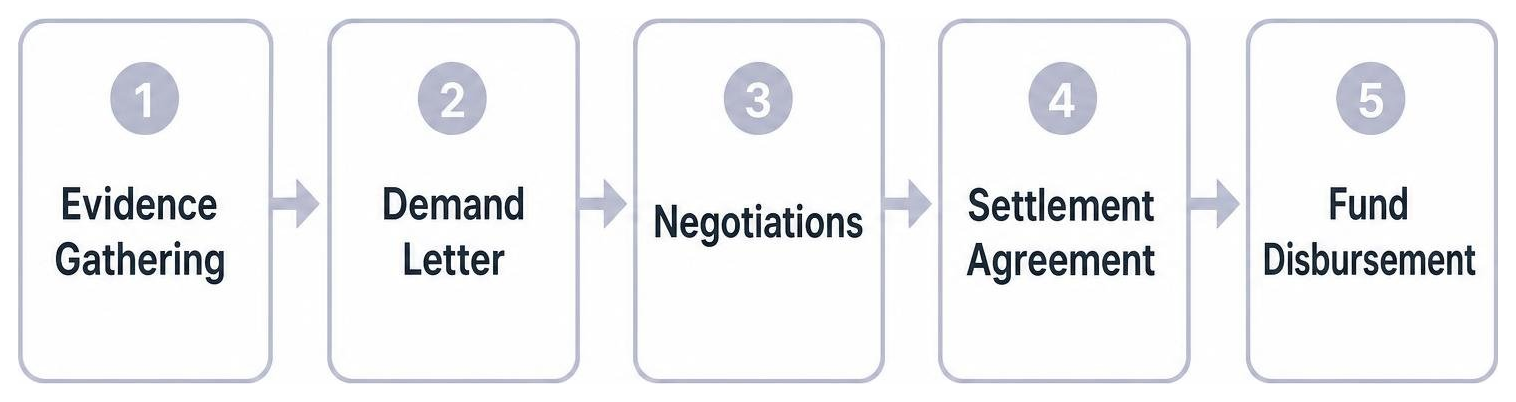
The Legal Roadmap: From Evidence Gathering to Settlement Payout
Pursuing a civil lawsuit follows a clear procedural framework. Working with our attorneys ensures every step is executed with precision.
Standing, Documentation, and Critical Evidence
To launch a valid claim, a plaintiff must possess legal standing—typically held by the surviving spouse, children, next of kin, or the individual who executed the funeral purchase contract. Essential evidence to compile includes:
- The initial Statement of Funeral Goods and Services Selected and final itemized bills.
- Proof of payments, bank drafts, and trust account confirmations.
- All email threads, text messages, and written correspondence with the mortuary.
- Photographs or video documentation showing physical errors, casket defects, or improper conditions.
- Medical, psychological, and prescription records demonstrating therapy for severe emotional trauma.
Demand Letters, Tax Allocations, and Attorney Ethical Duties
Once evidence is organized, legal counsel drafts a formal demand letter outlining liability, statutory breaches, and a specific settlement figure. If negotiations stall, the parties often turn to formal mediation before trying the case in court.
When structuring a settlement, tax allocations matter significantly under Internal Revenue Service (IRS) regulations:
- Reimbursements for Economic Loss: Restitution for direct funeral costs and actual out-of-pocket expenses is generally non-taxable.
- Emotional Distress Damages: Compensation for emotional distress that does not stem directly from an observable physical injury or physical illness is typically treated as taxable income.
- Punitive Damages: Always fully taxable at state and federal levels.
Attorneys owe strict fiduciary duties to their clients throughout this process. As demonstrated in the Galilee Memorial Gardens litigation, counsel is ethically required to relay and review all settlement offers with the client.
Frequently Asked Questions About Funeral Home Claims
For additional legal resources and insights, browse our FAQ section.
Who has legal standing to file a funeral home lawsuit?
Standing rests with the designated next of kin possessing legal authority over the decedent’s remains (under state right-of-sepulcher statutes) or the contracting party who signed the goods and services agreement.
How are funeral malpractice settlement proceeds taxed?
Taxability depends on the damage classification in the settlement agreement. Pure economic restitution for out-of-pocket costs is generally excluded from gross income, whereas standalone emotional distress compensation and punitive damage awards are taxable.
What is the statute of limitations for filing a funeral negligence claim?
Deadlines range between one and three years depending on state law. In many cases, the statutory clock begins on the date the negligence occurred or when it reasonably should have been discovered. Consult our latest blog posts for updates on statutory limits.
Conclusion
When a funeral provider breaches the sacred trust placed in them, families deserve financial justice and emotional closure. We are dedicated to holding negligent operators accountable while guiding families through complex civil recoveries.
If your family has experienced mortuary neglect or fraud, please contact us for a free consultation today. Learn how our comprehensive funeral malpractice legal representation can protect your rights and secure the compensation you deserve.