
When Burial Rights Are Violated, Start With the Records
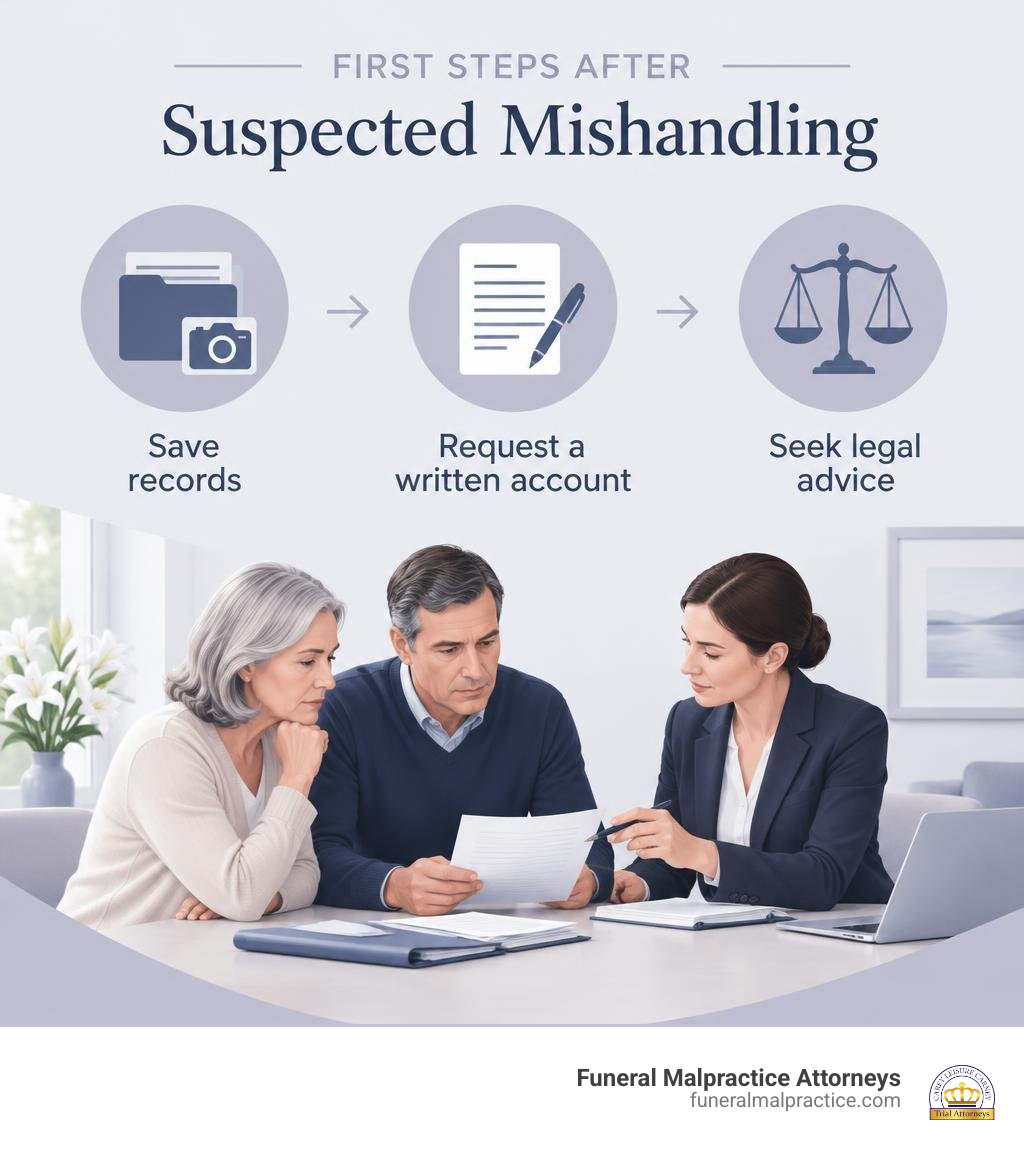
If you believe a funeral home, crematory, or cemetery mishandled your loved one’s remains, save every record and contact a burial rights violation attorney promptly. Keep contracts, consent forms, receipts, photos, and messages. Ask the provider for a written account of what happened, and write down whom you spoke with and when. An attorney can review who had authority over the remains, what went wrong, and whether you may have a claim.
You do not need to sort through this alone. Funeral Malpractice Attorneys offers free consultations to families facing funeral, crematory, or cemetery negligence in the Clearwater, Florida, area.
I’m Tom Carey, a Florida-based legal professional in Pinellas County who has served as a senior partner at a law firm. I’ll help you understand what to bring to a burial rights violation attorney and which questions to ask first.
What Is the Right of Sepulcher Under New York Law?
Much of the best-known case law on burial rights comes from New York, so we use it here to show how courts think about these claims. Florida has its own rules, so a Clearwater family should always have a local review. The core ideas, though, travel well.
The right of sepulcher is a common-law right that goes back hundreds of years. It is the right to choose and control burial, cremation, or other final disposition of a body. In New York, next of kin hold an absolute right to immediate possession of the decedent’s body for preservation and burial. If someone unlawfully interferes, the family can sue for damages.
Courts have described this right as less like property ownership and more like the right to find solace and comfort in the ritual of burial. That helps explain why these claims center on mental anguish rather than on a dollar value for the remains.
New York Public Health Law § 4201 sets out who decides when the decedent has not named someone. The order looks like this:
| Priority | Who holds authority |
|---|---|
| 1 | Agent named in a valid written appointment |
| 2 | Surviving spouse |
| 3 | Children |
| 4 | Parents |
| 5 | Other next of kin |
Who Has Authority to Control Disposition of Remains?
Next of kin have the primary rights over remains. Anyone outside that circle needs a written, signed, and witnessed appointment. New York’s Department of Health publishes an appointment of agent form for this purpose. Naming an agent in advance is one of the simplest ways to prevent a fight later.
Disputes happen when several people share the same rank, such as three adult children who disagree. Agreement is usually needed, and when it cannot be reached, a court may have to decide. A verbal “it’s fine with me” from a sibling is a shaky foundation. Written consent protects everyone.
What Conduct May Violate Burial Rights, and What Are the Exceptions?
Courts recognize three classic ways of interfering with the right of sepulcher:
- An unauthorized autopsy.
- Inadvertent disposition of remains, including remains that are lost, misplaced, or misidentified.
- Failure to notify next of kin of the death, which can lead to burial before family can act.
There are limits. The right does not override a medical examiner’s statutory authority. A medical examiner may perform autopsies and forensic testing when a death involves criminal violence, an accident, or a suicide. The same applies to sudden death in apparent health, a death unattended by a physician, or a suspicious or unusual death. That authority reaches the removal of organs, tissue samples, and fluids needed for testing. Where criminality is suspected, the district attorney must be notified.
So a lawful, authorized examination is not a violation. Mishandling the remains afterward can be.
When to Hire a Burial Rights Violation Attorney

Not every painful funeral experience is a legal claim. A good legal evaluation asks whether someone interfered with your right to immediate possession in an unauthorized way, and whether that interference caused you mental anguish. Depending on the facts, the responsible party might be a hospital, a municipality, a funeral home, or a cemetery. Our guide to understanding funeral malpractice and common legal grounds for claims covers how these theories overlap.
When Should You Contact a Burial Rights Violation Attorney?
Reach out as soon as you notice any of these:
- The burial location is being withheld or cannot be confirmed.
- Remains were mishandled, misplaced, or misidentified.
- Remains were disposed of, buried, or cremated without your authorization.
- You were never told your loved one had died.
Prompt review matters for practical reasons. Records are easier to collect while they are fresh, and witnesses forget. Some claims also carry short deadlines. Claims against government bodies, for example, often require a formal notice of claim within a short window. In New York that can be as little as 90 days for many municipal claims. We cannot give a one-size deadline here, because the right period depends on the defendant and the facts. That is exactly why early legal review is worth it.
How a Burial Rights Violation Attorney Can Assess the Evidence
An attorney typically works through a checklist:
- Next-of-kin status. Are you the person with the right to possession?
- Consent forms. What did you or another family member sign, and what did it authorize?
- Notice history. When and how were you told about the death, the remains, and the burial?
- Actual interference. Was something lost, misidentified, buried, or otherwise mishandled?
- Mental anguish. Did the interference cause it, and can it be shown?
Two decisions show why these details matter.
In Taylor v. New York City Health & Hospitals Corp., decided in 2025, a mother of premature twins signed burial consent forms. She was later told the remains were preserved and available. She did not retrieve them, even after about eight years. The court dismissed her claim. The remains were never lost or buried, and a bereavement counselor’s mistaken comment did not change that. The court also set out the elements a plaintiff must prove: next-of-kin status, a right to possession, unauthorized interference with immediate possession, awareness of the interference, and resulting mental anguish.
In Zhuangzi Li v. New York Hospital Medical Center of Queens, decided in 2017, fetal remains were misplaced en route to pathology and later found in a bin with other body parts. The appellate court held that a hospital can be liable for mishandling remains if its forms and statements created a reasonable expectation of burial, even for a fetus under 20 weeks. Signing a burial consent form relinquished the parents’ right to immediate possession, but they could still pursue mishandling tied to the burial. Emotional distress from a delayed autopsy alone was not recoverable.
The Taylor opinion also contrasts a 2020-era line of cases in which a family prevailed. A teenage son was misidentified and buried as an unidentified person. The family was not told his identity for over a month, and the exact burial location was withheld for years. Courts found real questions about interference there. The lesson is simple: lost, misidentified, secretly buried, or late-notified remains are very different from remains that were safe and available all along.
What Families Should Do After Suspecting a Violation

You are grieving, so we keep the to-do list short and doable:
- Preserve evidence. Keep originals of every document and take photos of anything relevant.
- Request written explanations. Ask the funeral home, hospital, or cemetery to put its account in writing. Politely, but in writing.
- Document communications. Note dates, names, and what was said. Save texts, voicemails, and emails.
- Do not alter or discard records. Even papers that seem unimportant, or that upset you, may matter later.
- Do not sign new releases or settlement paperwork until someone has reviewed it.
These steps help an attorney see which legal ground fits, whether negligence, breach of contract, or interference with burial rights.
What Evidence and Remedies May Be Relevant?
Helpful records usually include:
- The death certificate.
- Consent and authorization forms.
- Burial permits.
- Medical records.
- Cemetery records and plot deeds.
- The funeral contract and receipts.
- Emails and call logs.
- Photographs.
- Witness statements.
Evidence of mental anguish also counts. Examples include a counselor’s notes, medical visits, or a written account you make now while memories are clear.
The principal remedy in a sepulcher case is damages for the mental anguish caused by the interference. Some cases, like the hospital case involving a premature infant’s remains found in commercial laundry, have ended in six-figure verdicts. Results depend heavily on the facts, so no outcome is guaranteed. Filing deadlines also vary case by case, which is another reason to ask early.
How Is a Sepulcher Claim Different From Disinterment?
The two are easy to confuse, but they solve different problems.
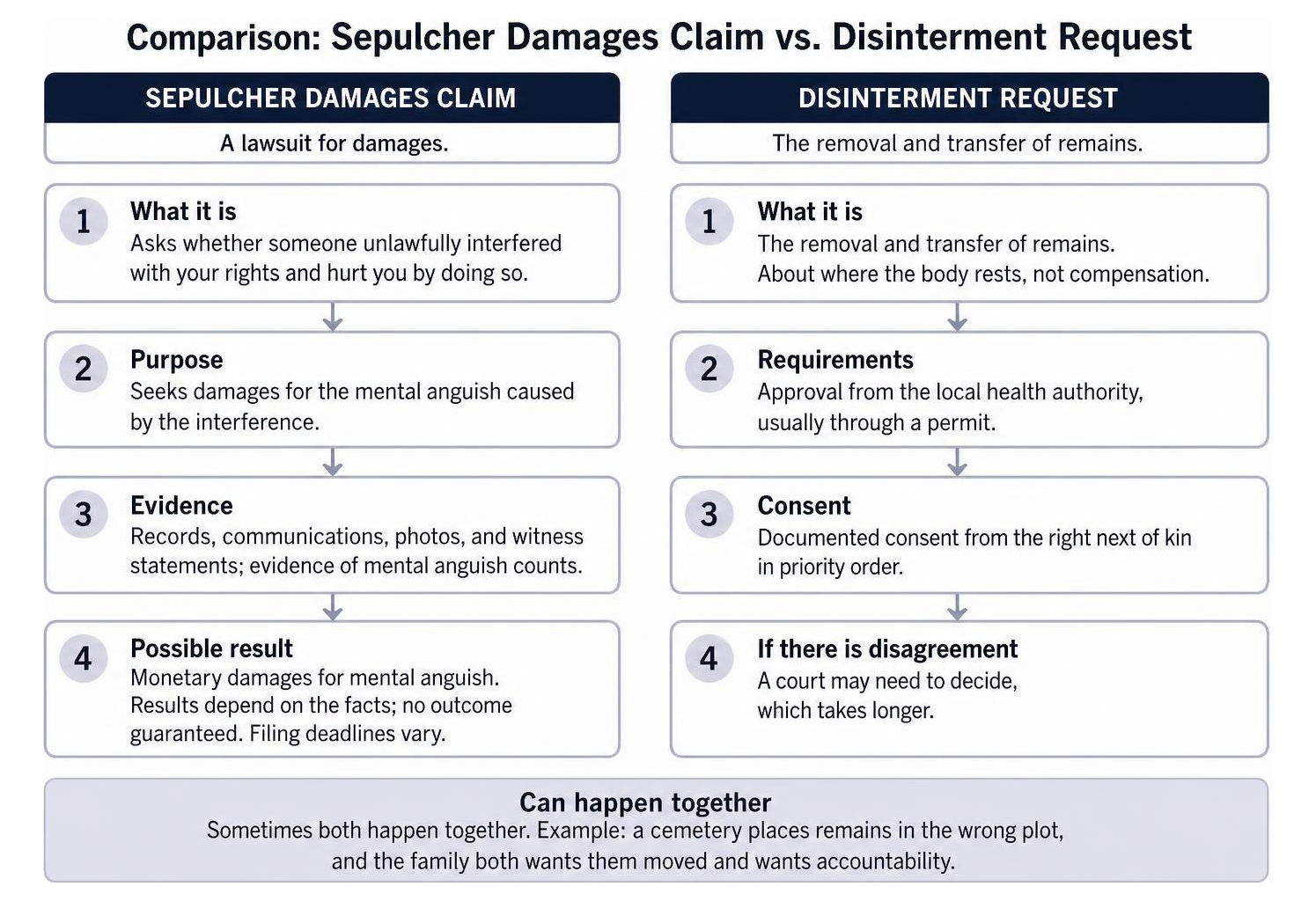
- A sepulcher claim is a lawsuit for damages. It asks whether someone unlawfully interfered with your rights and hurt you by doing so.
- Disinterment is the removal and transfer of remains. It is about where the body rests, not about compensation.
Disinterment generally requires approval from the local health authority, usually through a permit, plus documented consent from the right next of kin in priority order. Where family members disagree, a court may need to decide, which takes longer. Sometimes both happen together. A cemetery places remains in the wrong plot, for example, and the family both wants them moved and wants accountability. Our cemetery negligence legal recourse guide explains the accountability side in more depth.
How Can Families Guard Against Deceptive Funeral Practices?
Prevention is far easier than a lawsuit. New York’s consumer guidance offers a solid model for questions to ask any provider:
- Ask for the itemized General Price List. Funeral homes must give it on request, in person or by phone, with no commitment.
- Review the written statement of services. It should list every item, its cost, and the total after you make selections.
- Buy outside if you like. You may buy a casket or urn elsewhere, and the funeral home cannot charge extra to handle it.
- Skip what you do not need. A funeral home cannot force embalming, viewing, or a formal ceremony for direct cremation. Embalming is legally required only in limited situations.
- Watch third-party charges. Crematory, cemetery, and obituary fees are often separate from the funeral home’s quoted price.
- Know prepaid-contract rights. Money must be held in trust and earn interest. If you change your mind before death, you are entitled to a refund plus interest.
- Know where to complain. In New York, the Attorney General’s office takes complaints about deceptive practices at 1-800-771-7755.
- Explore burial assistance. Low-income families can apply through the county Department of Social Services within 120 days of death, and veterans may qualify for a supplemental allowance.
Costs add up quickly. A viewing, ceremony, and burial in New York averages over $8,500 before the plot or cremation, so asking questions is worth the awkwardness. Keep copies of everything you sign.
Frequently Asked Questions About Burial Rights Violations
Can a hospital or medical examiner conduct an autopsy without family permission?
Sometimes, yes. A medical examiner has statutory authority to perform an autopsy and forensic testing in cases involving suspicious, unattended, or sudden deaths in apparent health. A death from violence, accident, or suicide also qualifies. In those cases, the family’s right of sepulcher does not block the examination.
An unauthorized autopsy outside those circumstances can be a violation. Even an authorized examination can lead to a claim if the remains are later mishandled, lost, or released improperly. The key distinction is between authorized testing and mishandling.
Can a family request disinterment years after burial?
Generally, yes. We found no general time bar on disinterment. The same requirements apply whether the burial was last month or decades ago:
- Documented consent from the right next of kin.
- Approval from the local health authority.
- A permit in the proper form.
- A destination cemetery that will accept the remains.
Old burials can be harder because records may be missing or incomplete, and a new chain of authority may need to be established. That can slow things down but is usually not a dead end. If remains are going out of state, expect additional permitting.
What should I do if remains are missing or the burial location is unknown?
Take these steps right away:
- Send written requests to the hospital, funeral home, medical examiner, and cemetery asking where the remains are and who handled them.
- Ask for confirmation of the decedent’s identity and any records showing how it was verified.
- Request agency records, such as burial permits and transfer logs.
- Contact the cemetery directly and ask for plot and interment records.
- Save every response, including silence. Note the date you asked and when, or whether, they answered.
- Seek legal advice promptly, since delayed notice and withheld burial locations are the kinds of facts courts take seriously.
Conclusion
Here is the short version. Save your records, ask for written explanations, and do not throw anything away. Find out who had authority over the remains, and compare what happened against that. Then have the facts reviewed under the law that applies to you. The New York cases above show how much turns on consent forms, notice, and whether the remains were truly mishandled. Florida families should expect a Florida-specific review.
At Funeral Malpractice Attorneys, we focus on funeral, crematory, and cemetery negligence and approach every family with compassion. Our free consultation is a no-pressure way to talk through what happened and learn your options. You can meet attorneys experienced in funeral-related claims and take the next step when you are ready.