

Can You Sue a Funeral Home for Emotional Distress? Legal Grounds and Standards
Yes, you can sue a funeral home for emotional distress when mortuary errors cause severe mental anguish. Families may pursue claims under negligence, intentional infliction of emotional distress, or breach of contract. When families entrust a mortuary with the care of a deceased relative, an implicit and legal bond of trust is formed. Under the law, funeral service providers are held to a specialized standard of care. Because mortuary services inherently deal with profound human vulnerability, courts recognize a unique legal relationship between morticians and grieving relatives, commonly referred to as the special relationship doctrine.
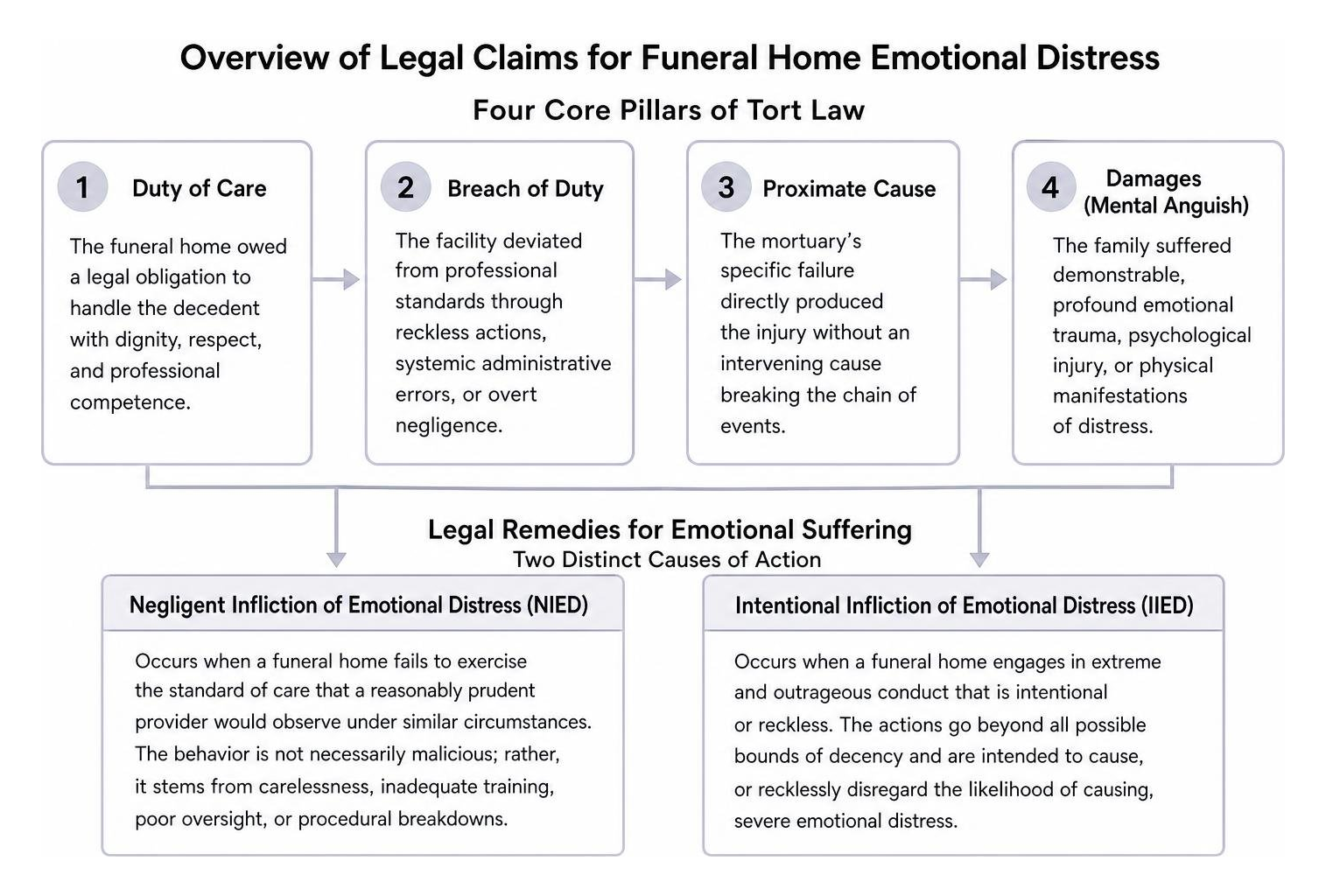
To establish a valid claim for mental anguish, a plaintiff must establish four core pillars of tort law:
- Duty of Care: The funeral home owed a legal obligation to handle the decedent with dignity, respect, and professional competence.
- Breach of Duty: The facility deviated from professional standards through reckless actions, systemic administrative errors, or overt negligence.
- Proximate Cause: The mortuary’s specific failure directly produced the injury without an intervening cause breaking the chain of events.
- Damages (Mental Anguish): The family suffered demonstrable, profound emotional trauma, psychological injury, or physical manifestations of distress.
Understanding funeral malpractice and common legal grounds for claims is critical when determining how a facility failed in its responsibilities.
When Can You Sue a Funeral Home for Emotional Distress Under Negligence vs. IIED?
Legal remedies for emotional suffering generally fall under two distinct causes of action: Negligent Infliction of Emotional Distress (NIED) and Intentional Infliction of Emotional Distress (IIED).
- Negligent Infliction of Emotional Distress (NIED) occurs when a funeral home fails to exercise the standard of care that a reasonably prudent provider would observe under similar circumstances. The behavior is not necessarily malicious; rather, it stems from carelessness, inadequate training, poor oversight, or procedural breakdowns.
- Intentional Infliction of Emotional Distress (IIED) requires a significantly higher evidentiary threshold. To prevail on an IIED claim, the plaintiff must prove that the mortuary’s conduct was “extreme and outrageous”—so shocking that it exceeds all bounds of decency tolerated in a civilized community. Furthermore, the defendant must have acted intentionally or with reckless disregard for the certainty that severe emotional distress would follow.
A foundational precedent in mortuary litigation is Meyer v. Nottger, Supreme Court of Iowa, 1976, where a funeral director engaged in outrageous behavior, including misrepresenting the condition of a decedent’s body, exerting undue pressure regarding casket selection, and mishandling the funeral procession, ultimately causing severe distress and subsequent physical complications for family members.
| Legal Claim | Standard of Conduct Required | Intent Level | Common Examples |
|---|---|---|---|
| Negligent Infliction (NIED) | Failure to exercise reasonable professional care | Carelessness, oversight, systemic neglect | Mislabeled ashes, lost documentation, delayed burial |
| Intentional Infliction (IIED) | Extreme and outrageous conduct exceeding civilized norms | Intentional or reckless disregard of consequences | Concealing body decomposition, unauthorized harvesting, fraudulent embalming |
Breach of Contract and Implied Covenants in Mortuary Services
Unlike typical commercial agreements for goods or general services, a contract with a funeral establishment is inherently personal. The primary objective of a mortuary contract is not commercial gain for the consumer, but dignity, closure, and peace of mind.
Because of this personal nature, courts across numerous jurisdictions recognize that a breach of a mortuary agreement carries the foreseeable risk of severe mental anguish. When a mortuary violates express terms or implied covenants—such as the implied covenant to handle remains with dignity and professional skill—plaintiffs can often recover emotional distress damages directly through contract actions.
Attorneys navigating these complex cases frequently reference authoritative resources, noting that litigators must ensure they don’t let a remains-mishandling case haunt you by properly pleading both tort and contract breaches to protect the client’s full recovery rights.
Common Mortuary Errors That Trigger Emotional Distress Claims
Industry studies show that roughly 25% of funeral homes have documented negligence cases across recent reporting periods, and an estimated 40% of families facing mortuary errors report significant psychological trauma. Operational carelessness and disregard for strict standard-of-care protocols are the primary drivers of these lawsuits.
Body Mix-Ups, Unauthorized Cremations, and Improper Embalming
Few errors are as devastating to a family as discovering that the body prepared for a viewing is not their loved one. Body mix-ups occur when facilities fail to maintain strict identification wristbands and transfer protocols.
Even more permanent are unauthorized cremations, where a mortuary cremates a body contrary to the explicit religious or personal instructions of the family. Embalming failures—resulting in accelerated decomposition, visible discoloration, or fluid leakage during open-casket visitations—can leave lasting traumatic memories for surviving relatives.
Misplaced Remains and Lost Cremated Ashes
Cremation errors remain a continuous area of mortuary liability. Annually, approximately 150 cases of mislabeling ashes are reported across the industry. When a facility loses track of cremated remains, provides the wrong urn, or commingles the ashes of multiple individuals in a shared retort or processing machine, families are deprived of closure.
When establishing liability in these circumstances, families often ask whether you can sue a funeral home for losing ashes. The answer is yes, as failures in chain-of-custody protocols represent direct violations of professional obligations.
Mortuary Exploitation, Fraud, and Desecration
Financial exploitation and physical desecration represent some of the most egregious mortuary violations. Practices such as switching a high-end casket chosen and purchased by the family for an inferior cardboard container prior to burial or cremation constitute actionable fraud.
Families can seek legal protection and remedies to protect grieving families from mortuary exploitation and embezzlement schemes when morticians charge for services never performed or illegally harvest bodily implants or tissues without statutory consent.
How State Laws and Legal Doctrines Impact Mortuary Lawsuits
State statutory frameworks and common-law doctrines create varying hurdles for emotional distress recovery. The Federal Trade Commission’s (FTC) Funeral Rule enforces price disclosure transparency nationwide, but tort actions and licensing accountability are governed entirely at the state level.
How State Impact Rules Determine if You Can Sue a Funeral Home for Emotional Distress
Historically, many states adhered strictly to the “Physical Impact Rule,” which barred plaintiffs from recovering emotional distress damages unless the emotional trauma was accompanied by a direct physical impact or immediate physical injury.
Over time, courts developed the “Modified Impact Rule” and the “Zone of Danger Doctrine.” A vital example of judicial analysis surrounding these thresholds is found in Miller v. May, Indiana Court of Appeals, 1995, which evaluated the boundaries of physical impact requirements versus standalone emotional distress claims against funeral directors. In many modern jurisdictions, mortuary malpractice is carved out as a specific exception to traditional impact rules because severe emotional trauma is the direct and foreseeable result of mishandling human remains.
Legal Standing: Who Has the Right to Sue for Mental Anguish?
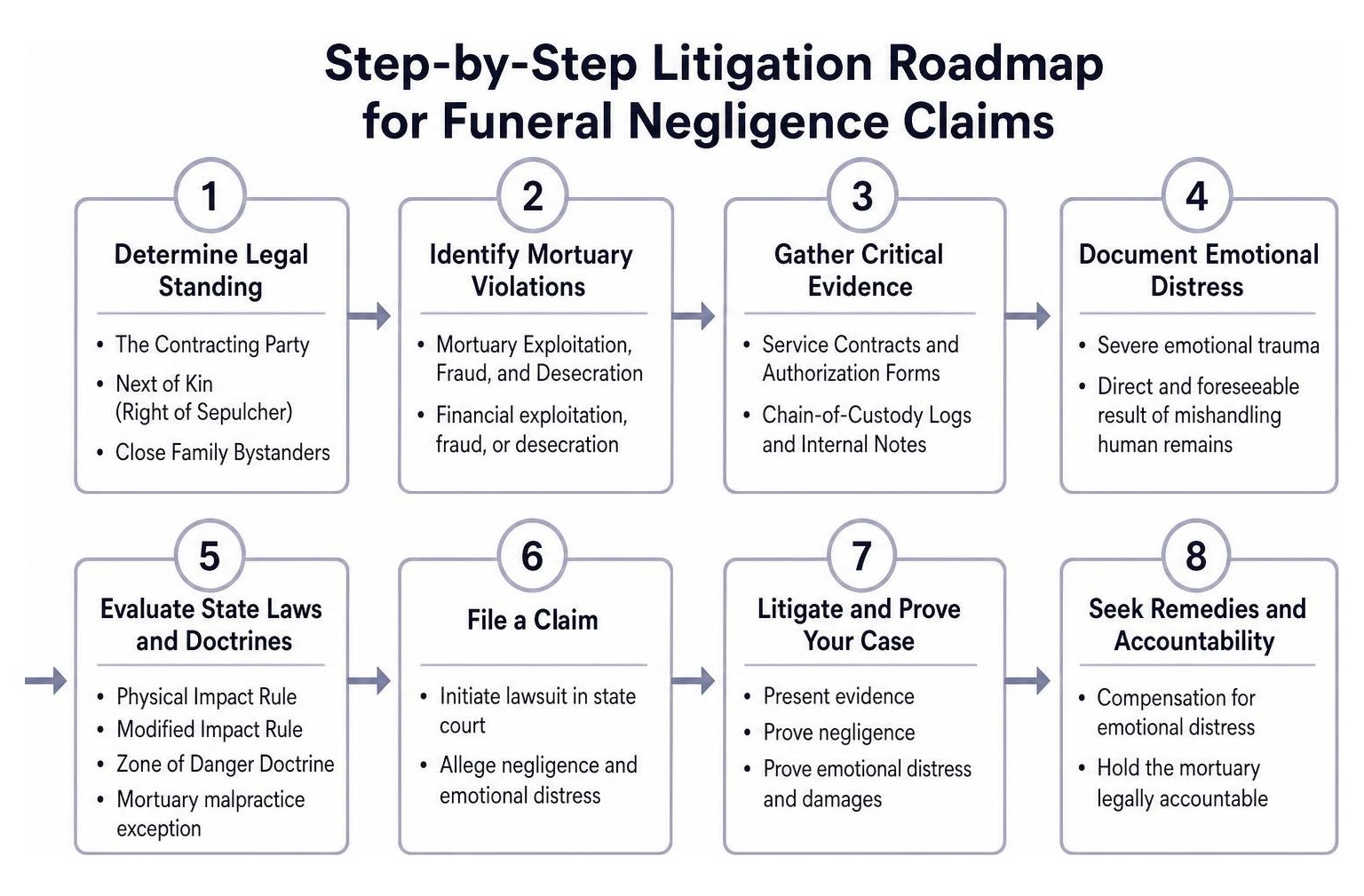
Not every relative possesses the legal authority (standing) to file a lawsuit against a mortuary. Generally, the right of action follows a structured statutory hierarchy:
- The Contracting Party: The individual who signed the agreement and assumed financial responsibility for the arrangements.
- Next of Kin (Right of Sepulcher): The surviving spouse, followed sequentially by adult children, surviving parents, and adult siblings.
- Close Family Bystanders: In exceptional circumstances involving egregious or outrageous conduct, close family members who attended the botched service or witnessed the desecration may assert independent emotional distress claims.
Evidence and Steps Required to Prove Emotional Distress in Court

Successfully resolving a mortuary lawsuit requires systematic evidence collection and formal documentation of the harm suffered.
Critical Evidence Needed to Build a Mortuary Negligence Case
To construct a compelling case against a negligent mortuary, our legal team gathers extensive documentation:
- Service Contracts and Authorization Forms: Documents showing explicit instructions regarding burial, embalming, or cremation.
- Chain-of-Custody Logs and Internal Notes: Administrative logs demonstrating where the body was transferred and who handled it.
- Visual Documentation: High-resolution photographs or video recordings showing physical defects, incorrect caskets, or improper storage conditions.
- Medical and Psychological Records: Diagnostic evaluations, therapy session notes, and treatment receipts establishing conditions such as Post-Traumatic Stress Disorder (PTSD), severe clinical depression, insomnia, or anxiety resulting from the event.
- Expert Witness Testimony: Sworn statements from licensed funeral directors and mortuary science authorities certifying how the facility violated state licensing standards and professional practices.
Damages, Settlement Values, and Litigation Success Rates
Plaintiffs in mortuary malpractice actions may recover multiple classes of damages:
- Economic Damages: Direct financial losses, including funeral costs, exhumation and reburial fees, corrective cremation charges, and mental health therapy bills.
- Non-Economic Damages: Compensation for emotional anguish, pain and suffering, loss of enjoyment of life, and severe psychological distress.
- Punitive Damages: Additional financial penalties awarded in cases involving gross negligence, intentional fraud, or wanton disregard for human dignity.
Industry litigation data indicates an overall 85% success rate for families pursuing legitimate mortuary malpractice claims through settlement or trial verdict, with the average settlement amount across documented negligence cases reaching approximately $250,000.
Frequently Asked Questions About Mortuary Negligence Lawsuits
What is the average settlement for suing a funeral home for emotional distress?
While case values depend entirely on the severity of the misconduct and the degree of psychological trauma, the average settlement amount for funeral home negligence is approximately $250,000. Catastrophic cases involving systemic fraud, mass uncremated remains, or deliberate desecration frequently yield higher results through jury verdicts or structured settlements.
Can non-contracting family members sue for emotional distress?
Yes, under specific circumstances. While the contracting party and the legal next of kin hold primary standing under the right of sepulcher, close family members who directly witness the consequences of outrageous mortuary misconduct can pursue claims under intentional infliction of emotional distress or expanded bystander recovery doctrines.
How long do you have to file an emotional distress lawsuit against a mortuary?
Lawsuits must be filed before the expiration of the applicable statute of limitations. Depending on your state, personal injury and negligence claims generally must be filed within two to four years from the date the negligence occurred or was reasonably discovered. Breach of contract claims may carry longer statutory windows. Consulting an attorney promptly ensures critical evidence is preserved before deadlines expire.
Conclusion
When a funeral provider fails in its duty to treat your deceased loved one with dignity, your family does not have to endure the emotional aftermath in silence. The law provides clear avenues for accountability, allowing families to seek financial compensation for severe mental anguish and administrative wrongdoing.
At Funeral Malpractice Attorneys, we provide specialized legal guidance and compassionate representation to hold careless mortuaries, cemeteries, and crematories accountable. If your family has suffered due to mortuary mishandling or exploitation, explore your rights with experienced funeral malpractice representation to secure the closure and justice your loved one deserves.